
Study Design
One of the largest BPDCN studies to date
CADENZA was a multicenter, open-label, single-arm Phase 1/2 clinical trial evaluating DECNUPAZ 0.045 mg/kg IV once every 3 weeks in adults with treatment-naïve* BPDCN with no CNS involvement or relapsed/refractory BPDCN without evidence of active CNS disease.1,2†

Relapsed/refractory patients with CNS disease could be included if previously treated and there was no evidence of CNS disease before first treatment dose.2
Key inclusion criteria2
- ECOG PS ≤1
- Adequate organ function
Exclusion criteria2
- Prior history of hepatic VOD, Grade 4 CLS, non-cardiac Grade 4 edema, related to prior tagraxofusp or other etiology
- Frontline patients with active CNS involvement confirmed by CSF analysis
*Included patients with de novo BPDCN (n=22) and patients with prior or concomitant hematologic malignancy (PCHM; n=11), with no CNS involvement.1
†Median follow-up of 21.5 months (range: 4.2–27.0) in treatment-naïve BPDCN. Median follow-up of 24.1 months (range: 0.2–30.4) in relapsed/refractory BPDCN.1
‡Remission (CR/CRc) is defined as complete remission (CR) or complete remission with residual skin abnormality not indicative of active disease (CRc).1
§Included patients who received 1–3 prior systemic therapies, including tagraxofusp, regardless of exposure duration.2
BPDCN=blastic plasmacytoid dendritic cell neoplasm; CLS=capillary leak syndrome; CNS=central nervous system; CR=complete remission; CRc=clinical complete remission; CSF=cerebrospinal fluid; ECOG PS=Eastern Cooperative Oncology Group Performance Status; HSCT=hematopoietic stem cell transplantation; IV=intravenous; VOD=veno-occlusive disease
A study population that reflected common clinical characteristics of BPDCN1,2
71%
(n/N=60/84)
65 years or older2
77%
(n/N=65/84)
skin involvement at
baseline2
82%
(n/N=69/84)
male2
CADENZA is one of the broadest BPDCN studies to date, including a variety of ages, fitness levels, and baseline disease involvement1,2||
| Patient Baseline Characteristics1,2 | ||
|---|---|---|
| TREATMENT-NAÏVE BPDCN (n=33) |
RELAPSED/REFRACTORY BPDCN (n=51) |
|
| Gender, N (%) | ||
| Male | 27 (82) | 42 (82) |
| Female | 6 (18) | 9 (18) |
| Race, N (%) | ||
| White | 27 (82) | 42 (82) |
| Black or African American | 1 (3) | 2 (4) |
| Asian | 0 | 1 (2) |
| Not reported | 5 (15) | 6 (12) |
| Ethnicity, N (%) | ||
| Hispanic or Latino | 4 (12) | 8 (16) |
| Non-Hispanic or Latino | 28 (85) | 38 (75) |
| Unknown | 1 (3) | 5 (10) |
| Age (years) | ||
| Median (range) | 73 (48–84) | 69 (19–85) |
| ECOG, N (%) | ||
| 0 | 12 (36) | 18 (35) |
| 1 | 21 (64) | 30 (59) |
| 2 | 0 | 2 (4) |
| 3 | 0 | 1 (2) |
| Disease involvement, N (%) | ||
| Skin | 31 (94) | 34 (67) |
| Bone marrow | 16 (48) | 24 (47) |
| Peripheral blood | 3 (9) | 10 (20) |
| Lymph nodes | 12 (36) | 18 (35) |
| Viscera | 0 | 3 (6) |
| Prior therapies, N (%) | ||
| Non-intensive chemotherapy | N/R | 32 (63) |
| Tagraxofusp | 0 | 29 (57) |
| Intensive chemotherapy | N/R | 25 (49) |
| Prior stem cell transplantation, N (%) | 0 | 16 (31) |
| Radiotherapy | 2 (6) | 9 (18) |
| Number of prior lines of therapy, N (%) | ||
| 1 | 0 | 29 (57) |
| 2 | 0 | 12 (24) |
| ≥3 | 0 | 9 (18) |
| Missing | 0 | 1 (2) |
| Median (range) | – | 1 (1–4) |
| Disease subgroup, N (%) | ||
| BPDCN de novo | 22 (67) | - |
| BPDCN with PCHMa | 11 (33) | - |
||Defined by ECOG PS of 0–1.
aPCHM is defined as any previously diagnosed or concurrently present hematologic malignancy at the time of BPDCN diagnosis.1
BPDCN=blastic plasmacytoid dendritic cell neoplasm; ECOG PS=Eastern Cooperative Oncology Group performance status; PCHM=prior or concomitant hematologic malignancy
Treatment-naïve BPDCN Results
Durable remission delivered in an outpatient setting1,2
DECNUPAZ is the first and only approved frontline BPDCN treatment administered outpatient from the start1,2*
High rate of CR/CRc† achieved in treatment‑naïve BPDCN (n=33)1
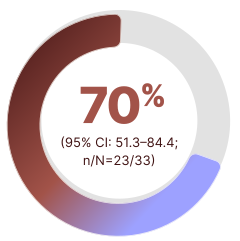
of patients achieved CR/CRc1
Median time to CR/CRc
- 1.8 months (range: <0.5–4)1
CR: 49% (95% CI: 30.8–66.5; n/N=16/33)1
CRc†: 21% (95% CI: 9.0–38.9; n/N=7/33)1
Median duration of CR/CRc
9.7
months
(95% CI: 2.9–NE)1‡
Median follow-up: 21.5 months (range: 4.2–27)1
Frontline BPDCN post-study treatment HSCT data

Patients bridged to transplant
~4
out
of
10
patients went on to receive post‑study treatment HSCT1
Transplant data in patients who achieved CR/CRc

48% (n/N=11/23)
of patients with treatment-naïve BPDCN who achieved CR/CRc† went on to receive post-study treatment HSCT4
Limitations: This post hoc analysis was not prespecified. No conclusions can be drawn.
*Actual clinical time may vary including premedication and post-infusion monitoring.1
†Remission (CR/CRc) is defined as complete remission (CR) or complete remission with residual skin abnormality not indicative of active disease (CRc).1
‡Kaplan-Meier estimate.1
BPDCN=blastic plasmacytoid dendritic cell neoplasm; CI=confidence interval; CR=complete remission; CRc=clinical complete remission; HSCT=hematopoietic stem cell transplantation; NE=not estimable
Relapsed/Refractory BPDCN Results
Durable remission even in challenging relapsed/refractory BPDCN1
CADENZA was the largest study in patients with relapsed/refractory BPDCN (n=51)1
CR/CRc*
16%
(95% CI: 7.0–28.6;
n/N=8/51)1
CR: 14% (95% CI: 5.7–26.3; n/N=7/51)1
CRc*: 2% (95% CI: 0.1–10.5; n/N=1/51)1
Median duration of CR/CRc
9.2
months
(range: 2.7–27.6+)1†
Median follow-up: 24.1 months
(range: 0.2–30.4)1
Patients with relapsed/refractory BPDCN:
- 0–3 was the range of ECOG scores1
- 69 years of age was the median (range: 19–85)1
- 47% had bone marrow involvement (n/N=24/51)1
- 35% had lymph node involvement (n/N=18/51)1
Relapsed/refractory BPDCN post-study treatment HSCT data
Patients bridged to
transplant
~1 out
of 10 (n/N=6/51)
patients went on to receive
post‑study treatment HSCT1
Transplant data in patients
who achieved CR/CRc
38% (n/N=3/8)
of patients who achieved CR/CRc* went on to receive post-study treatment HSCT4
Limitations: This post hoc analysis was not prespecified. No conclusions can be drawn.
With DECNUPAZ, relapsed/refractory patients may have a chance at complete remission1
*Remission (CR/CRc) is defined as complete remission (CR) or complete remission with residual skin abnormality not indicative of active disease (CRc).1
†Kaplan-Meier estimate.1
+=censor indicator; BPDCN=blastic plasmacytoid dendritic cell neoplasm; CI=confidence interval; CR=complete remission; CRc=clinical complete remission; ECOG=Eastern Cooperative Oncology Group; HSCT=hematopoietic stem cell transplantation; NE=not estimable

Request a representative
If you would like to learn more about DECNUPAZ, sign up to connect with a representative. They can help answer the questions you may have.
Request A Rep