One outpatient infusion
of DECNUPAZ every 21 days1,2
Continue until disease progression
or unacceptable toxicity1
Dosing

One outpatient infusion
of DECNUPAZ every 21 days1,2
Continue until disease progression
or unacceptable toxicity1
Premedications required
Weight-based dosing
Rapid administration
Infusion monitoring and management
Outpatient infusion from the start2
*30–60 minutes prior to each DECNUPAZ infusion.1
†This does not include administration of premedications or monitoring.
Administer premedications the day prior to and on the day of the infusion of DECNUPAZ to reduce the risk of infusion-related reactions.1
| Recommended Premedications Prior to Each DECNUPAZ Infusion1 | |||
|---|---|---|---|
| ADMINISTRATION TIME PRIOR TO DECNUPAZ INFUSION |
PREMEDICATION | ROUTE OF ADMINISTRATION | DOSE (OR EQUIVALENT) |
| Day before DECNUPAZ infusion | Corticosteroid | Oral or IV | Dexamethasone 8 mg twice daily |
| 30–60 minutes prior to infusion | Corticosteroid | IV | Dexamethasone 8 mg |
| Antihistamine | IV | Diphenhydramine 25 mg to 50 mg | |
| Antipyretic | Oral | Acetaminophen 325 mg to 650 mg | |
AST=aspartate aminotransferase; BPDCN=blastic plasmacytoid dendritic cell neoplasm; CLcr=creatinine clearance; IV=intravenous; ULN=upper limit of normal

If you have questions about dosing, or would like support, sign up to connect with a representative. They can help answer the questions you may have.
Request A RepPreparation & Administration
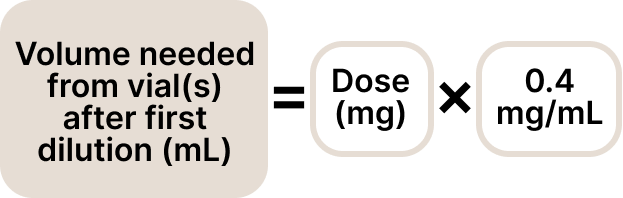
Important preparation instructions
DECNUPAZ requires reconstitution followed by two dilutions prior to administration. Read the entire Instructions for Preparation section carefully before preparing and administering DECNUPAZ1
View full details for reconstitution, dilution, administration, and storage by clicking each topic.
BPDCN=blastic plasmacytoid dendritic cell neoplasm; IV=intravenous
Treatment Modifications
| Recommended Dosage Modifications for Adverse Reactions1 | ||
|---|---|---|
| ADVERSE REACTION | SEVERITYa | DOSE MODIFICATION GUIDELINES |
| Veno-occlusive disease | Any Grade |
|
| Increased AST or ALT | Either AST or ALT is >2.5 × the ULN |
|
| Increased bilirubin | Total bilirubin >1.5 × the ULN |
|
| Infusion-related reactions | Grade 2 |
|
| Grade 3 |
|
|
| Grade 4 |
|
|
| Edema | Grade 1 (5–10% inter-limb discrepancy in volume or circumference, 4 kg weight gain, or 1+ pitting edema [2 mm]) |
|
| Grade 2 (10–30% inter-limb discrepancy in volume or circumference, >4 kg weight gain, or 2+ pitting edema [4 mm]) |
|
|
| Grade 3 (>30% inter-limb discrepancy in volume, or 3+/4+ pitting edema [>6 mm]) |
|
|
| Grade 4 (life-threatening) |
|
|
| Other non-hematologic adverse reactions | Grade 3 |
|
| Grade 4 |
|
|
aNational Cancer Institute Common Terminology Criteria for Adverse Events Version 4.03; Grade 1 is mild, Grade 2 is moderate, Grade 3 is severe, and Grade 4 is life‑threatening.1
ALT=alanine aminotransferase; AST=aspartate aminotransferase; BPDCN=blastic plasmacytoid dendritic cell neoplasm; IV=intravenous; ULN=upper limit of normal

DECNUPAZ can be purchased from Specialty Distributors or Pharmacies. You can find contact details for specialty distributors and pharmacies for easy ordering.
See Ordering InfoHepatotoxicity, Including Hepatic VOD
Infusion-Related Reactions
Edema
Sulfite Allergic Reactions
Embryo-Fetal Toxicity
DECNUPAZ™ (pivekimab sunirine-pvzy) is indicated for the treatment of adult patients with blastic plasmacytoid dendritic cell neoplasm (BPDCN).
Please see full Prescribing Information, including BOXED WARNING, or visit https://www.rxabbvie.com
US-DECB-260004
REFERENCES:
1. DECNUPAZ [package insert]. North Chicago, IL: AbbVie Inc.
2. Pemmaraju N, Marconi G, Montesinos P, et al. Pivekimab sunirine in blastic plasmacytoid dendritic cell neoplasm. J Clin Oncol. 2026;00:1-13.